
We recently added a thermal imaging camera to our RV inspection toolkit. Like many inspection tools, it gives us another way to observe what is happening inside an RV while its systems are being operated.
But thermal imaging is also one of those technologies that can easily be misunderstood.
A thermal camera does not allow an inspector to “see through walls,” and a colorful thermal image does not automatically indicate that something is wrong. What thermal imaging can do is show differences in surface temperature that may provide additional information, document operation, or identify an area that deserves a closer look.
That makes it useful during an RV inspection, but only when it is considered in the context of the larger RV inspection.
A Recent Example: Looking at Furnace Operation
One of the simplest examples came during a recent inspection while testing the RV furnace.
Normally, an inspector can operate the furnace, verify that it starts, check the airflow at the registers, and document whether the system appears to be functioning normally.
With thermal imaging, we can add another observation.
As the furnace operated, the thermal camera clearly showed the temperature difference between the heated air/register area and the surrounding interior surfaces. Instead of documenting only that the furnace was producing heat, we could supplement the inspection report with an image showing the thermal conditions observed while the system was operating.
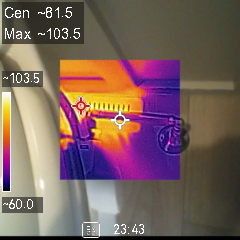
This does not suddenly make the thermal camera a furnace diagnostic tool. It does not tell us whether every internal component of the furnace is operating perfectly, nor does it replace the normal inspection and operational testing of the system.
What it does provide is another piece of information.
And that is really where thermal imaging fits into an RV inspection.
Another Example: Heated Seating
Thermal imaging can also be useful for documenting the operation of smaller comfort features that might otherwise be evaluated primarily by touch.
During another recent inspection, we activated the seat heaters built into an RV couch. The thermal camera clearly showed localized warming across the heated seating areas.
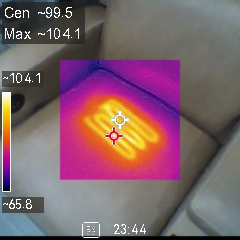
The thermal image does not tell us how long those heating elements will continue to operate or predict their future reliability. What it does provide is visible documentation that the seating surfaces responded thermally when the heaters were activated during the inspection.
That may seem like a relatively simple example, but it illustrates an important point: thermal imaging does not have to uncover a hidden defect to add value to an inspection.
Sometimes its value is simply providing another way to document what we observed.
Thermal Imaging Shows Temperature Patterns
A thermal camera detects infrared energy and translates differences in surface temperature into an image. It is looking at the temperature of the surfaces we can observe, not literally looking through those surfaces to see what is behind them.
Those temperature patterns can sometimes draw attention to conditions that are difficult or impossible to recognize visually.
For example, thermal imaging may help us compare the operation of heating and cooling systems, observe temperature differences around HVAC registers, identify an unusual temperature pattern around an electrical component while it is under load, or notice an area of a wall, ceiling, or floor that behaves differently from the surrounding material.
Depending on the RV and the conditions at the time of the inspection, it may also provide useful observations around doors, windows, plumbing fixtures, and other areas where temperature differences exist.
None of those observations automatically represents a defect.
They give the inspector information to consider along with everything else being observed during the inspection.
What About Water Intrusion?
This is probably one of the areas where thermal imaging is most easily misunderstood.
A thermal camera does not detect water inside a wall.
Moisture can sometimes create a different thermal pattern than surrounding dry material because of factors such as evaporation and differences in how the materials heat and cool. Under the right conditions, that temperature difference may appear on a thermal image.
That can be valuable because an unusual pattern may give us a reason to investigate an area more closely.
But a thermal anomaly alone does not establish that water intrusion exists.
If we see something suspicious, we still need to consider the visual condition of the area, surrounding seals and components, moisture-meter readings when appropriate, previous repairs, and other available evidence before drawing a conclusion.
In other words, thermal imaging can help us ask a better question.
It doesn’t necessarily provide the answer by itself.
Electrical Systems Are Similar
Thermal imaging can also be useful when observing electrical equipment.
Electrical components often produce heat while operating, so simply finding a warm breaker, connection, or component does not automatically mean that there is a problem. What may be more useful is an unexpected temperature difference when compared with similar components operating under similar conditions.
If something stands out thermally, that observation can then be considered along with the rest of the electrical inspection.
Again, context matters.
The thermal camera is helping identify something that may deserve additional attention. It is not independently determining why the condition exists or whether a component has failed.
The Numbers on the Screen Also Require Context
It is tempting to look at a thermal image, see a temperature displayed on the screen, and assume that number represents a precise measurement of the object being viewed.
It is not always that simple.
The accuracy of thermal measurements can be affected by the surface material, reflectivity, distance, ambient conditions, and a property known as emissivity. Shiny or polished metal surfaces are particularly problematic because they can reflect infrared energy from surrounding objects rather than accurately representing their own temperature.
That is another reason we are more interested in what the thermal image contributes to the inspection than in treating every temperature displayed by the camera as an absolute diagnostic measurement.
For something like our furnace example, the important observation may be the clear temperature difference associated with the operating heating system; not simply a single number displayed on the photograph.
Another Tool in the Inspection Toolkit
There is no single piece of equipment that can provide a complete picture of an RV’s condition.
A moisture meter doesn’t replace a roof inspection. An electrical tester doesn’t replace operating the RV’s electrical systems. A thermal camera doesn’t replace visual inspection, operational testing, or the other tools used throughout the inspection.
They work together.
That is how we view thermal imaging.
We don’t expect the camera to magically uncover every hidden defect in an RV. Instead, it provides another way to observe how the RV and its systems are behaving at the time of the inspection.
Sometimes it provides better documentation of something we already know, such as confirming a clear thermal response while a furnace is operating.
Other times, it may reveal a temperature pattern that gives us a reason to take a closer look.
And occasionally, what we don’t see can be useful information as well.
The value isn’t simply owning a thermal camera.
The value is knowing where that information fits within the much larger picture of an RV inspection.